

Nations as micro humanities
The concept of humanity represents the ultimate human whole, the broader human civilization of which all people feel themselves to be a part. Yet, from its very beginnings, human civilization has been remarkably diverse, composed of distinct local cultures, or sub-collectivities if you will, much like a galaxy is composed of its star systems. It is precisely these distinct cultural entities that I define as nations. In my view a nation is a distinct cultural entity.
As humanity spread geographically, the vast distances separating different groups made interaction between them impossible, and the first distinct cultural entities, or the world’s earliest nations, began to take shape. Over time, through the changes that time inevitably brings, these cultural entities transform, disappear, merge, split apart, assimilate into one another, and evolve into new forms.
These cultural bubbles, acting as cultural attractors, create among their members a sense of a shared, familiar environment, satisfying the innate human need to belong. Gradually, they give rise to a common identity that, through its influence on the human psyche, shapes individual behavior, value systems, aspirations, and decisions, ultimately influencing the course of human history.
This characteristic of humanity, its evolution through autonomous, identity-bearing communities expressed in distinct cultures, may have both advocates and critics but in my view, its benefits far outweigh its drawbacks, not only for ethical and aesthetic reasons, but also for pragmatic ones, as cultural diversity strengthens humanity’s resilience and helps safeguard its long-term well-being.
If, for example, one culture declines due to the dominance of flawed ideas or any other internal or external cause, another contemporary culture may be flourishing and prosperous, thereby preventing humanity as a whole from descending into darkness. Moreover, however strongly one may believe that their own culture and way of life are uniquely right or destined to determine humanity’s fate, the truth is that no one knows whether any grand objective purpose exists, let alone what that purpose might be. How, then, could anyone objectively determine who is moving in the right direction and who is not? More on this argument here. In any case, regardless of our judgments, this diversity of identities is a fact, and understanding it is therefore, at the very least, useful.
At the root of this diversity of cultures and consequently of identities lies “homoism” (as I prefer to call it), the human need to belong to a group of one’s own kind. This tendency has clear evolutionary roots, as group membership historically provided protection against outsiders.
But what are the fundamental constituent elements that define a cultural entity and distinguish it from another? Based on their historical significance, I would identify five fundamental attributes to which all others may be reduced. Each carrying different weight depending on the historical era, the identity and the individual:
- Language
- Religion
- Historical Memory
- Political Organization
- Genetic Composition
Even a single difference between two entities may be sufficient to establish some degree of cultural differentiation. Naturally, the greater the number and significance of these differences, the more culturally distinct the entities become. Thus, there are nations that are remarkably similar (consider Americans and Canadians) and others that differ substantially across nearly all dimensions (say, Somalis and Finns).
This indicates that a nation is not firmly defined by exactly five attributes. On one hand there are examples of stateless nations, like the Jewish nation, whose identity was sustained for centuries largely through religion and historical memory, while on the other hand there are nations for which political organization (the existence of two different states) is their most important distinguishing factor. In the USA and Canada example, one could argue that they could be categorized as a single nation, since large segments of their population share three out of five fundamental attributes (language, religion and genetic composition) with a large part of their historical memory being common too. However, the mere existence of two different states, gradually forms a distinct historical memory and in the long run, it can form a distinct cultural entity and consequently a new identity. Conversely, if the main differentiator was to disappear, the two entities might gradually converge into one single cultural entity.
We can represent nations as five-dimensional objects, with each dimension corresponding to one fundamental characteristic. Depending on the similarity of their identities, some of these objects may lie closer to one another, while others may be farther apart. The projections of these objects onto lower dimensions may also function as identities in their own right, and overlapping projections indicate similarity. Every such object and projection constitutes a distinct identity which, as a cultural attractor, influences the course of human history. Since it is cognitively easier to reason in three dimensions, I use simplified three-dimensional representations in the provided illustrations.
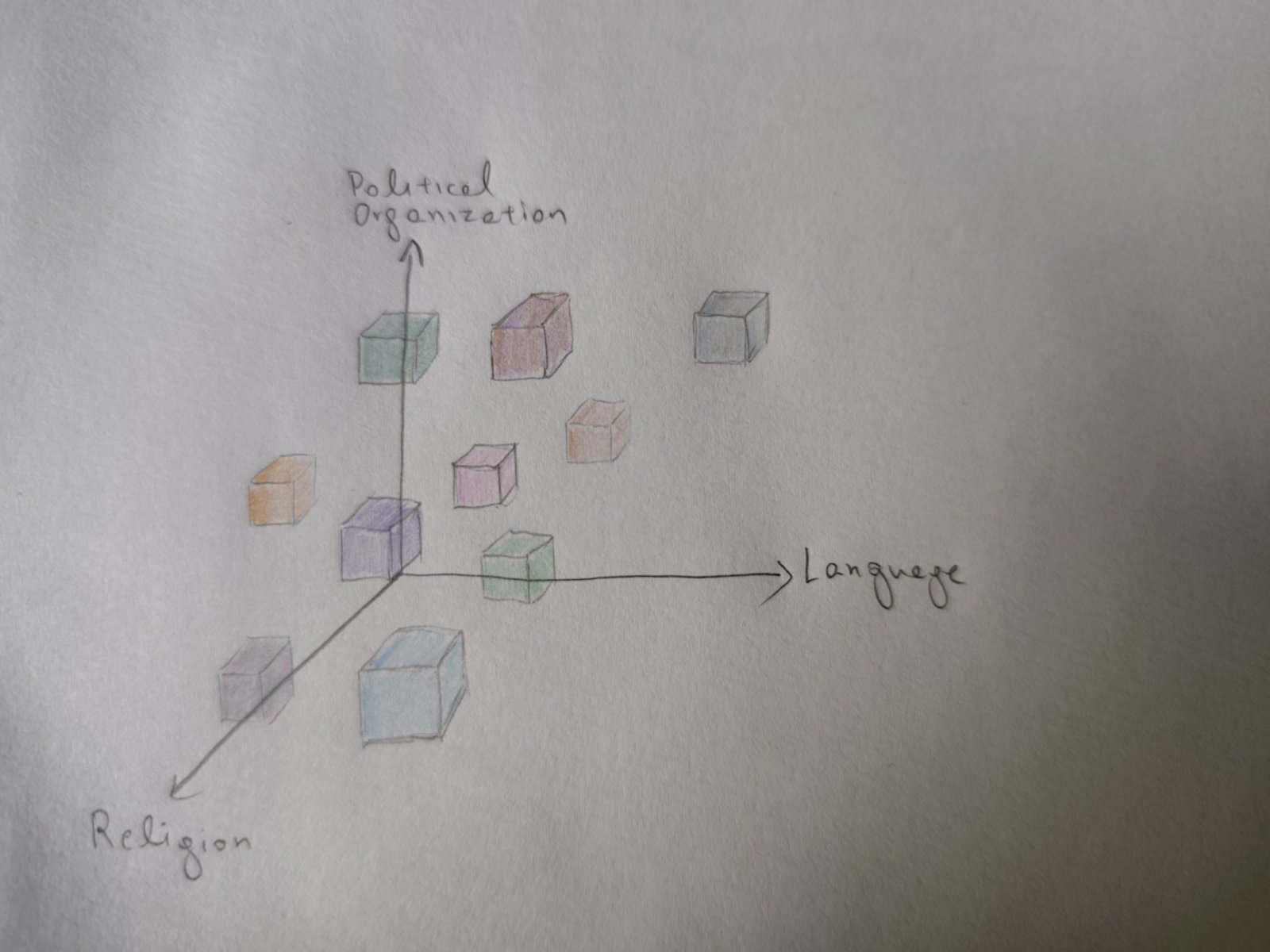
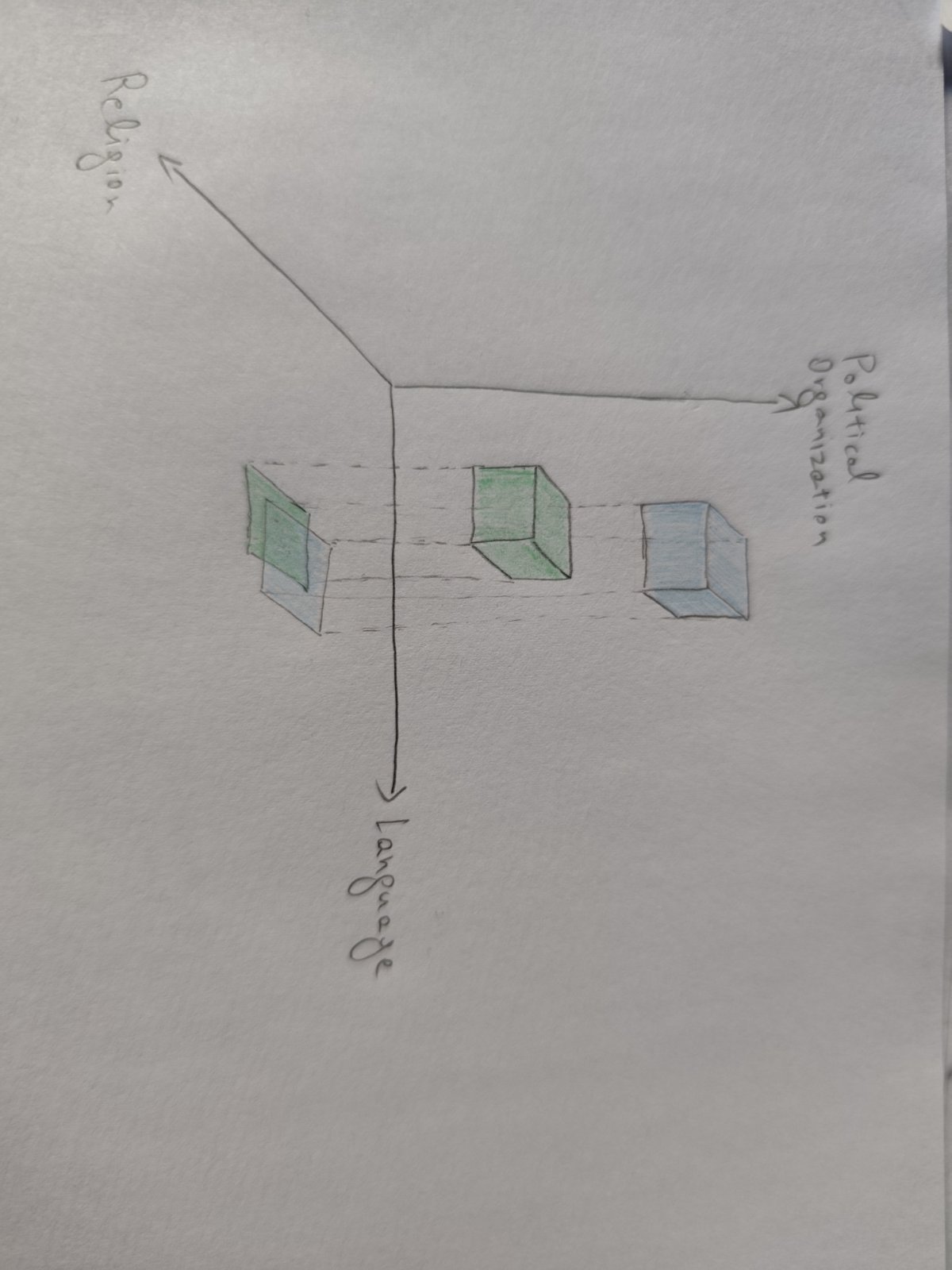
We can also use this framework to understand the process of national assimilation. Assimilation involves the gradual transformation of the characteristics that distinguish one population from another. As these characteristics change, often at different rates, new intermediate identities may emerge before the process reaches its eventual outcome. Since such transformations can unfold over many generations, historical snapshots allow us to observe populations at different stages of cultural assimilation.
One example comes from medieval Iberia, where Muslim rule lasted for several centuries. During this period, much of the native Iberian population underwent a gradual process of Arabization, adopting elements of the dominant Arabic language and culture. In the course of this transformation, various intermediate identities emerged, occupying positions somewhere between the original Iberian cultures and the increasingly Arabized society of al-Andalus.
One such group was the Mozarabs, Christians living under Muslim rule who adopted significant elements of Arabic language and culture while retaining their Christian religion. Conversely, another group, the Muwallads, consisted largely of indigenous Iberians, converted to Islam while retaining varying degrees of their earlier linguistic and cultural heritage. These communities illustrate how religious and linguistic assimilation can proceed independently, giving rise to distinct cultural identities along the way.
Another example is that of the Karamanlides, the Turkish-speaking Orthodox Christian communities of Cappadocia and other parts of Asia Minor. They spoke Turkish as their native language while retaining their Orthodox Christian faith and religious traditions. Particularly interesting is the fact that they were writing Turkish using the Greek alphabet and as a result, we can find the Old and New Testament written in Turkish but with Greek letters.
Following the population exchange agreement between Greece and Turkey in 1923, most of Karamanlides were relocated to Greece. Their case is especially revealing because it demonstrates how a population can share the language of one cultural community while maintaining strong religious and historical ties to another.
Some observations
In this framework, historical memory has a very large scope. It contains customs and traditions. It includes not only past events but also present events of great importance, such that they are already considered historical. For example, theater in classical Greece was already regarded by contemporaries as a defining element of their cultural identity so its existence was already of historical importance. The American flag on the Moon is another such case. I classify such significant cultural elements under historical memory.
Locality greatly enhances the historical memory and thus strengthens the sense of identity that is affected by it.
Political organization reflects the way a society is structured, how it makes decisions, distributes resources, educates the young, manages security and challenges, defines rights and obligations. The modern state is the most familiar form of political organization and plays its own great role in identity formation. There are cases where the populations of two neighboring states share four of the five primary characteristics but differ in political organization, and this alone may generate identity differentiation. Besides, over the course of time this differentiation in political organization can gradually create its own historical memory pushing even more towards a distinct identity. Examples include the United States and Canada, North and South Korea, Romania and Moldova and others. This also implies that if the difference in political organization ceases to exist, identities may converge into one.
The way of life (customs, traditions, myths, practices, music, architecture, cuisine and so on) or what we commonly refer to as shared culture, is a derivative of historical memory and religion as well as political organization and language.
Any projection of a five-dimensional identity onto lower dimension spaces can function as a distinct cultural attractor. Multidimensional identities thus possess multiple expressions and shades.
The same characteristic may be of minor importance in one identity but far more significant in another. Genetic composition for example, plays little to no role in the case of the United States. Its identity has been shaped to encompass multiple genetic profiles, effectively rendering it independent of them, leading to a more generic identity that spans the entire 5th dimension (or alternatively it can be thought of as a generic 4d identity instead of a narrower 5d one). By contrast, in the case of China, genetic composition plays a much more substantial role.
Any combination of any number of the five basic characteristics, capable of generating emotional identification and differentiation from others, can function as a distinct identity and begin to influence the course of human history. For example the Jews were stateless for centuries, they were spread out in Europe, they spoke variations of the local languages and were members of the local political organizations, yet their main collective identity was defined by religion and historical memory. These two attributes alone maintained their sense of national identity. In extreme cases, even a single characteristic might suffice to initiate a process of identity autonomy. However, such a nascent identity would be highly fragile and prone to merging with neighboring ones.
The closer two identities are, the more likely it is that they will merge into one, or that one will absorb the other. A case in point is the Normans, who were ultimately absorbed into the kingdoms of France and England, despite having a highly significant political organization that endured for roughly two centuries and influenced medieval Europe, to a point that it started generating its own historical memory. However, 4 of the 5 characteristics were very similar to those of neighboring kingdoms. Once their political organization collapsed, maintaining a distinct identity became impossible. Language and religion have been, and remain, the dominant attributes of differentiation.
Self-perception, and perception by others, is a product of identity differentiation and homoism.
Solidarity arises from shared self-perception.
The use of a distinct name for an identity reinforces its differentiation from others.
The position of the volume occupied by an identity changes over time. Identities evolve.
These five primary characteristics have been decisive in identity formation from the deep past to the present, though their influence may vary over time and place.
There are many historical processes that could be examined through this lens, processes that unfold over centuries, for example the Hellenization of Anatolia and its subsequent Turkification, the temporary emergence of the Mozarab and Muladi identities in the Arabic Iberia, the Arabization of Egypt etc.
The purpose of this post is to briefly present a simple mechanistic framework through which we can understand historical processes and project future developments in a structured way.
Meta-identities
Identities are not static entities. They evolve slowly over time. Most ancient cultural branches that have survived to the present day (Chinese, Greeks, Indians, Iranians, etc.) have passed through different civilizational epochs, undergoing major transformations along the way.
The Greeks, specifically, have passed through three major epochs and two major transitions: Mycenaean to Classical to Orthodox (using the term Orthodox here in a broad cultural sense, not merely in its religious aspect). Each cultural phase forms a distinct identity without however, beginning from a blank slate. Rather, it incorporates the previous one and evolves from it, forming a continuous “identity branch”. This process never stops. Identities continue to evolve even within a single epoch, although the changes are milder.
Understanding the characteristics that define an identity, together with knowledge of its historical path, facilitates the recognition of an identity branch which, in the Greek case, encompasses the Mycenaean, the Classical and the Orthodox form. When viewed as a whole, we can form the notion of an “identity of identities,” or a meta-identity. An identity that spans the entire branch.
More about the Greek case
During the first major transition from the Mycenaean to the Classical form, the Bronze Age Collapse and the subsequent Dark Ages brought profound transformations. The political organization changed dramatically. The palatial system collapsed and the great administrative centers were largely abandoned. Parts of the historical memory were lost, most notably the writing system. Religion also evolved. Some deities disappeared while others rose to prominence or assumed new roles. Yet the fundamental religious worldview remained largely unchanged. The Greek language survived, and with it many elements of historical memory, including myths, legends and heroic traditions. These transformations unfolded over several centuries, until, at the other end, a new cultural entity emerged as a continuation of its predecessor yet distinct from it. This new entity continued to evolve until the next transition, although at the slower pace of a stable civilizational epoch. While political organizations changed repeatedly, all other aspects of identity evolved much more mildly.
The subsequent transition from the Greco-Roman antiquity to the medieval christian world, produced the most profound transformation of the Greek identity: from its Classical to its Orthodox form. The most obvious change was, of course, the adoption of Christianity, accompanied by fundamental changes in the political organization, following the fall of Rome and the crystallization of a new entity, the Eastern Roman Empire. Over the course of several centuries, the Orthodox identity of “Romios” (Roman) took shape to describe the Orthodox, Greek speaking citizen of the empire. The term “Hellenes” used by classical Greeks to describe themselves, had been associated with paganism during the proto-christian period and was intentionally being avoided for that reason. Consequently, this new Orthodox identity distanced itself from its own “pagan” past.
An interesting fact is that because the title of “Rome” carried immense political weight, both the west and the east were claiming it for themselves while denying it to the others. Westerners were called Franks or Latins by the Byzantines while the Eastern Roman Empire was called the empire of the Greeks by westerners.
So, in addition to the Greek language and through it, much of the historical memory of the previous era survived. Students were still educated with Homer, as they did in the classical age and scholars were copying, commenting and mimicking the classics. In a way, as the Mycenaean world co-shaped the Classical one, the Classical world co-shaped the Orthodox one, although in a smaller degree due to the challenges that followed the rise of Christianity. Ultimately, the most fortunate consequence of this enduring continuity was the European Renaissance, which was ignited by the Byzantine scholarship that preserved, copied, and ultimately transmitted the classical works to the west, following the Fall of Constantinople.
It’s worth noting that way before the modern greek enlightenment of the 18th century, the Byzantine intelligentsia started to openly acknowledge its roots, as is evident from the writings especially after the 4th crusade. The irony is, that after the greek war of independence the pendulum has swung to the other side. Despite the fact that the modern greek identity lies closer to the Byzantine Orthodox one, it has been disproportionately associated with its classical form especially in the eyes of foreigners. In any case using the concept of “meta-identities” we can incorporate them all under one entity.
A few words about the Turkish case
The notion of a meta-identity can also be observed in younger cultures. Turkish culture for example, exhibits a comparable pattern when viewed across a sufficiently long historical timescale. The sense of identity of a 7th-century AD nomadic Tengrist Göktürk of the Asian Steppe would have differed profoundly from that of a modern Muslim Turk in Asia Minor. Nevertheless, the Göktürks are rightly regarded as part of the broader Turkish cultural heritage, as reflected in the modern Turkish education system, cultivating a Turkish meta-identity that transcends the distinct historical identities that compose it.